Can Strawberries Thrive in Subtropical Climates Using Vertical, Soilless Substrate Systems?
Strawberries grown in subtropical climates need production systems that stabilize moisture, temperature, and disease pressure over the entire season. Modern vertical, soilless, substrate-grown systems can allow strawberries to thrive even in hot, humid regions by improving drainage, reducing leaf wetness, and protecting roots from excessive heat. When precise irrigation, better airflow, and controlled nutrient delivery are combined in these systems, subtropical strawberry production becomes not only technically feasible but also commercially reliable, provided the crop is managed correctly.
These systems do not eliminate climatic constraints, but rather shift them from uncontrollable field variables to manageable design and operational parameters.
Because strawberries evolved in environments characterised by moderate temperatures, high soil aeration and relatively stable moisture regimes, direct soil cultivation in hot climates often exposes them to stresses outside their physiological comfort zone. These constraints have pushed growers toward more structured systems where the root zone, water flow, and microclimate can be actively engineered instead of left to soil and weather variability. As subtropical regions face more frequent heavy rainfall and erratic temperature swings, vertical substrate systems increasingly provide a practical way to manage risks that the crop cannot tolerate naturally under conventional soil-based production1.
Why Vertical, Substrate-Based Farming Systems Work Better in Subtropical Strawberry Production
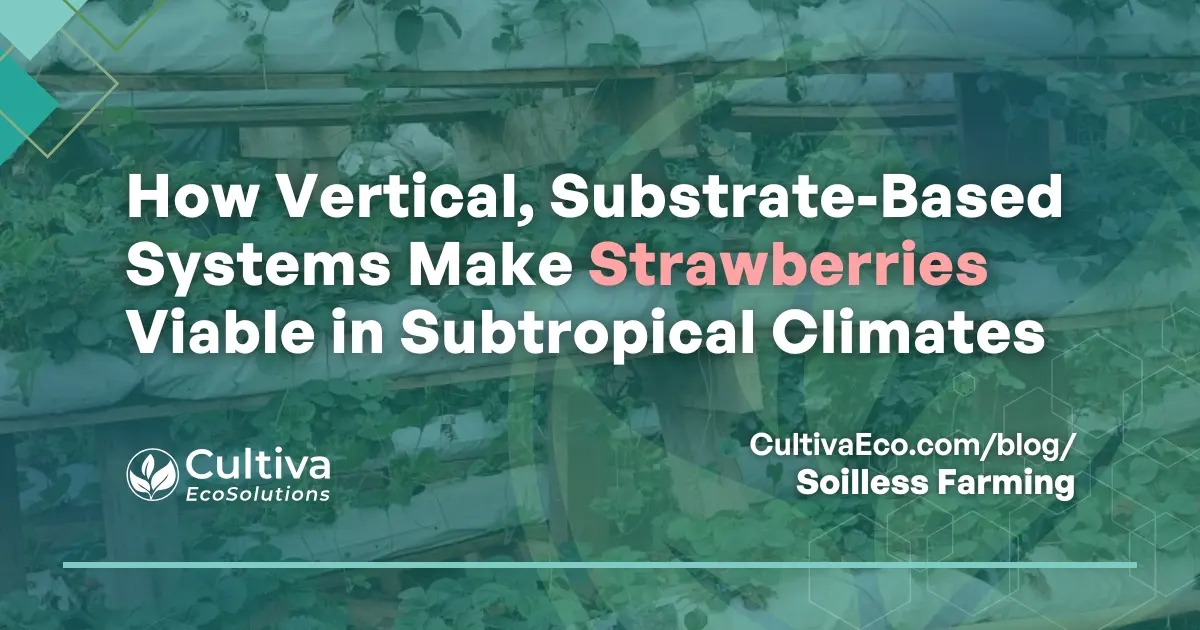
Vertical systems used for strawberries in warm regions typically rely on substrate-filled mats or gutters paired with high-uniformity irrigation lines. These systems lift the crop above ground, an important shift in climates where annual rainfall is high and soils remain wet for extended periods. Flooding, waterlogging, and soil splashing are not only agronomic inconveniences—they often translate into fruit soiling, physical damage, increased labor needs, and elevated disease incidence3.
By elevating the plants, the root zone avoids saturation during heavy rains, while substrate mixes when properly selected and managed can retain sufficient moisture while maintaining adequate oxygen availability in the root zone. Precise irrigation—often using short, frequent pulses—helps maintain a stable water curve, even during heat spells. This precision becomes critical when trying to balance the rapid evapotranspiration typical of subtropical afternoons with the crop’s shallow root system and sensitivity to prolonged dryness.
Substrates with poor air-filled porosity or excessive fine fractions can negate these benefits, especially under high-frequency irrigation.
Another advantage is operational efficiency. When planting areas are limited or fragmented, vertical systems allow higher planting densities without compromising airflow or harvesting access2. In regions where land costs or terrain restrict traditional rows, the spatial flexibility becomes a meaningful driver of adoption. Growers can also scale gradually, implementing vertical modules as they learn to calibrate substrate, irrigation, and fertigation for their climate.
How Elevated, Soilless Strawberry Systems Reduce Fungal Disease Pressure (Botrytis, Powdery Mildew)
In subtropical climates, humidity spikes favor Botrytis cinerea (gray mold) and Podosphaera aphanis (powdery mildew). Both pathogens thrive in poor airflow, dense canopies, and prolonged leaf wetness—conditions often unavoidable in soil systems during rainy seasons. Vertical strawberry cultivation reduces these issues by lifting foliage above wet ground and promoting natural airflow between tiers.
The reduced contact with soil and puddles limits direct splash transmission of spores. At the same time, lowering leaf-surface humidity decreases the likelihood of Botrytis infection during flowering or wet harvest windows. Powdery mildew, which spreads rapidly under warm and humid—but not fully saturated—conditions, becomes easier to manage when foliage is kept drier and more ventilated. These microclimate benefits help protect fruit quality and maintain uniformity for markets where appearance and shelf life are essential.
Fungal pressure is not eliminated outright, but the structural design of vertical systems allows growers to use fungicides more efficiently and reduce application frequency. Improved sanitation, drip-fed nutrients, and rapid drying after rain all contribute to a more predictable disease profile—something especially valuable in export-oriented production where consistency is monetized.
Disease outcomes remain strongly influenced by cultivar susceptibility, planting density, nutrition balance and weather patterns, with system design acting as a moderating rather than determining factor.
Water Use, Nutrient Recirculation, and Fertigation Efficiency in Vertical Soilless Strawberry Cultivation
One of the most consequential shifts from soil to substrate-grown strawberries is the potential to improve water-use efficiency, and where infrastructure and biosecurity protocols allow, to partially or fully recirculate irrigation water. In hot climates, traditional beds lose substantial moisture to surface evaporation—an inefficiency that becomes more pronounced during dry seasons or heatwaves. Vertical systems minimize these losses because water applied to the substrate remains within a semi-closed loop.
In many open or semi-open subtropical systems, growers operate with controlled drainage rather than full recirculation due to pathogen risk, water temperature management and regulatory constraints.
Nutrient stability also improves. In soil systems, nitrates and phosphates can leach deep into the profile during intense rainfall events, reducing nutrient-use efficiency and increasing costs. Within vertical gutters, fertilizer delivery is more consistent, and drainage volumes can be monitored to refine daily fertigation targets. This helps maintain EC and pH within ranges that strawberries prefer, even when ambient conditions fluctuate.
Water recirculation also enables better control over root-zone salinity. In climates where evaporation concentrates salts in the upper root zone, maintaining uniform moisture with short irrigation pulses reduces risk of salinity stress—an often overlooked factor in warm regions. Overall, vertical systems make water and fertilizer use more predictable and measurable, helping growers respond quickly when environmental stress increases, particularly during periods when high temperature and evapotranspiration accelerate salt accumulation in the root zone.
Managing Substrate Temperature and Root Stress in Subtropical Vertical Strawberry Systems
Despite the advantages of vertical cultivation, heat remains the defining constraint in subtropical strawberry production. During summer, substrate temperature can rise dramatically, especially in full-sun systems or those using dark-colored containers. Elevated root-zone temperatures disrupt water uptake, reduce oxygen availability, and can injure fine feeder roots responsible for nutrient absorption.
Strawberries respond to heat stress with visible symptoms: leaf wilting in mid-afternoon, uneven fruit set, tip burn, and reduced crown vigor. In many commercial cultivars, prolonged exposure to substrate temperatures above 30–32°C can result in cumulative root damage, especially when daily recovery periods are insufficient 4. These effects accumulate over the season if shading, cooling, or irrigation adjustments are not implemented.
For this reason, subtropical production systems need root-zone monitoring rather than relying solely on air temperature. Substrate thermometers or sensors help growers detect early heat accumulation, prompting corrective irrigation cycles or shading interventions. Overlooking substrate temperature is a common cause of underperformance in newcomers to vertical strawberry cultivation in warm climates.
Heat Mitigation Strategies for Strawberries in Vertical, Subtropical Soilless Systems
Mitigating heat stress requires combining several practices rather than relying on one solution. Shade nets typically in the range of 20–35%, depending on latitude, cultivar and production calendar, can lower radiative heat load and reduce midday substrate temperature peaks without excessively limiting photosynthesis5. In high-humidity regions, shading helps keep plant metabolism stable during critical afternoon hours when VPD becomes erratic.
Irrigation strategies also need adaptation. Instead of large, infrequent applications, short pulse irrigation early in the day maintains substrate moisture within an optimal band while avoiding prolonged saturation. During heatwaves, introducing cooling pulses—very short irrigation events timed for peak heat—helps stabilize root-zone temperatures. Cooling pulses should be used as a temperature-stabilisation tool rather than a cooling mechanism, and only where drainage capacity and oxygen supply are sufficient to prevent hypoxic stress.
Care must be taken not to over-irrigate, which can deprive roots of oxygen during warm nights.
Location also matters. Aligning rows to maximize airflow, avoiding reflective walls, and using light-colored substrates or containers all contribute to cooler root environments. Some growers incorporate evaporative cooling principles indirectly, such as using higher airflow corridors or reflective mulches to reduce heat absorption. These strategies, when applied together, form a resilient management framework for subtropical strawberry production.
When Vertical, Substrate-Based Strawberry Systems May Be Unsuitable
Vertical soilless systems may underperform in situations where reliable irrigation control is unavailable, drainage infrastructure is inadequate, or where labour and technical capacity are insufficient to support daily monitoring. In such cases, system complexity can amplify rather than reduce production risk.
How to Build a Profitable, Climate-Adapted Model for Subtropical Strawberry Production
Profitability in subtropical climates is not determined by yields alone but by consistency—maintaining commercial quality despite climatic variability. Vertical systems create a platform where irrigation, nutrient delivery, and microclimate management are far more controllable than in soil-based setups. This stability leads to fewer losses during rainy periods, more predictable harvest windows, and higher percentages of export-grade fruit.
However, achieving these outcomes requires a management mindset closer to greenhouse or high-tech horticulture than traditional open-field cultivation. Daily monitoring of substrate moisture, drainage, pH, temperature, and nutrient solutions becomes part of normal operations. When combined with rapid disease scouting and climate-adaptive irrigation plans, these practices reduce risk and create a reliable economic model.
The systems can become particularly profitable when targeting markets where shelf life, uniform berry size, and clean appearance command higher prices. Vertical strawberries often exhibit lower contamination risk, reduced bruising, and superior color development—attributes valued in premium and export channels6. With proper training and seasonal planning, subtropical producers can turn a climatically challenging region into a competitive advantage.
Conversely, insufficient monitoring, poorly matched substrates or inappropriate irrigation strategies can quickly erode these advantages, turning vertical systems into higher-cost versions of the same climatic risks faced in soil cultivation.
Expert Agronomic Support for Vertical, Substrate-Based Strawberry Systems (Cultiva EcoSolutions)
For growers navigating subtropical climates, the learning curve can be steep, especially when adapting irrigation, fertigation, and disease management practices to vertical systems. Agronomic guidance from experienced specialists helps shorten this adaptation period and minimize early-season errors.
Cultiva EcoSolutions provides support in areas such as climate-adaptive irrigation design, substrate strategy, disease prevention, and production system optimization for berries and high-value crops. For producers evaluating or scaling vertical strawberry systems, expert oversight can provide clarity, reduce risk, and ensure each season becomes more stable and predictable than the last.
Frequently Asked Questions About Vertical, Soilless Strawberry Systems in Subtropical Climates
Yes. When they are properly designed and managed, vertical, soilless, substrate-based systems make strawberry production technically feasible and commercially viable under appropriate management conditions. Elevating plants in substrate-filled gutters or mats improves drainage, keeps roots out of saturated soil and reduces mud splashing after heavy rainfall. Combined with precise irrigation, controlled fertigation and better airflow, these systems stabilise moisture, temperature and fungal disease pressure so that strawberries – a crop originally adapted to cooler conditions – can deliver consistent yield and quality under hot, humid weather.
In warm, high-rainfall environments, vertical strawberry cultivation offers several advantages over traditional soil beds. By lifting the crop above ground, the root zone avoids flooding, waterlogging and soil splashing, which are common after intense storms and often translate into dirty fruit, physical damage and higher disease pressure. Well-chosen substrate mixes hold water while maintaining oxygen, supporting the shallow root system of strawberries even during hot afternoons. High-uniformity drip lines allow short, frequent irrigation pulses that follow evapotranspiration without stressing the crop. In addition, vertical structures make it easier to use land efficiently, increase planting density where area is limited, and maintain good airflow and harvesting ergonomics – key factors in profitable subtropical strawberry production.
In subtropical climates, humidity spikes create ideal conditions for Botrytis cinerea (gray mold) and Podosphaera aphanis (powdery mildew), especially in dense, poorly ventilated canopies grown on soil. Vertical systems help by lifting foliage away from wet ground and puddles, which reduces splash-dispersed spores and lowers leaf wetness duration after rain or irrigation. The tiered structure naturally improves airflow through the canopy, so leaves and flowers dry faster and the microclimate becomes less favourable for infection. While fungicides and resistant varieties are still important, this structural disease management allows more targeted, efficient spray programs and supports the high fruit quality, colour and shelf life required for premium and export strawberry markets.
In vertical, substrate-grown strawberries, irrigation and fertigation should be treated as a controlled process rather than simple “field watering.” The goal is to keep substrate moisture within a narrow, stable band using short, frequent irrigation pulses that prevent both drought stress and prolonged saturation. Because drainage can be collected and measured, growers can monitor drainage percentage, EC and pH to fine-tune daily fertigation targets and avoid leaching of nitrates and phosphates during intense rainfall events. Where infrastructure allows, recirculating nutrient solution reduces water use, stabilises nutrient availability and provides better control of root-zone salinity – a critical factor in hot climates where evaporation tends to concentrate salts. This data-driven approach to irrigation and fertigation is central to achieving uniform growth, balanced plant nutrition and predictable yields in subtropical vertical strawberry systems.
Managing heat stress in subtropical vertical strawberry systems requires a combination of structural and irrigation-based strategies. Shade nets in the range of 20–35% can reduce radiative load and lower midday peaks in substrate temperature without excessively limiting photosynthesis. Irrigation schedules should favour early-morning pulses and, during heatwaves, very short cooling pulses at peak temperature to stabilise the root zone, always avoiding over-irrigation that would deprive roots of oxygen on warm nights. System design also matters: orienting rows to maximise airflow corridors, avoiding reflective walls and using light-coloured containers or substrates all contribute to a cooler root environment. Continuous monitoring of substrate temperature – not only air temperature – helps growers act before heat leads to wilting, tip burn, uneven fruit set or irreversible root damage.
References
- Hutchinson, G. K. , Nguyen, L. X. , Ames, Z. R. , Nemali, K. & Ferrarezi, R. S. (2025). Substrate system outperforms water-culture systems for hydroponic strawberry production. Frontiers in Plant Science , 16, 1469430. 🌐 Language: | View Article | PMC
- Palombini, M. C. , Palencia, P. , Pavão, J. M. S. J. & Chiomento, J. L. T. (2023). Efficiency of Strawberry Cultivation under the Effect of Different Types of Plants in a Soilless System in the High-Altitude Regions of Southern Brazil . Agronomy , 13(8), 2179. 🌐 Language: | View Article
- Louws, F. J. , Cline, W. & Bollenbacher, C. (2025). Gray Mold or Botrytis Fruit Rot of Strawberry. NC State Extension Publications . 🌐 Language: | View Fact Sheet
- Sakamoto, M. , Uenishi, M. , Miyamoto, K. & Suzuki, T. (2016). Effect of Root-Zone Temperature on the Growth and Fruit Quality of Hydroponically Grown Strawberry Plants . Journal of Agricultural Science , 8(5), 122. 🌐 Language: | View Article
- Righini, I. , Stanghellini, C. & Savini, G. (2025). Assessing the cooling effect of shade nets in walk-in tunnels: a trade-off between landscape regulations and strawberry production in the Trentino region (Italy) . In Savvas, D. , Bartzanas, T. & Ntatsi, G. (Eds.), Acta Horticulturae , 1437, 103–110. 🌐 Language: | View Article
- Treftz, C. & Omaye, S. T. (2015). Comparison between hydroponic and soil systems for growing strawberries in a greenhouse. International Journal of Agricultural Extension , 3(3), 195–200. 🌐 Language: | View PDF