Poland Country Council Role Announced by World Agriculture Forum
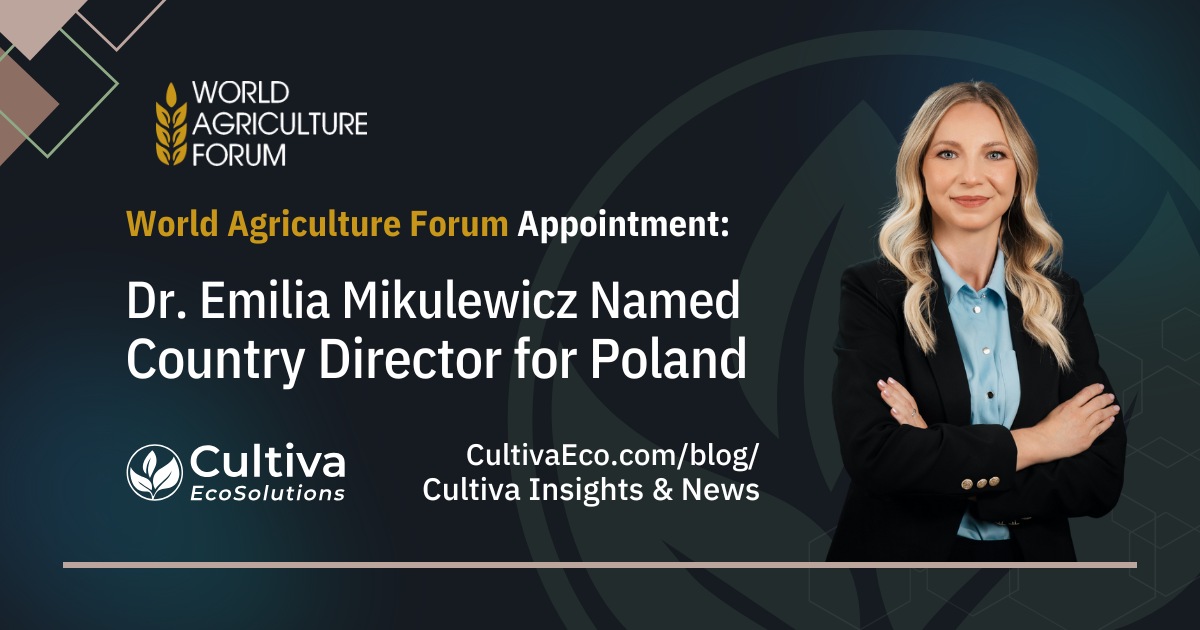
According to a recent announcement published by the World Agriculture Forum, Dr. Emilia Mikulewicz has been appointed Country Director for Poland.
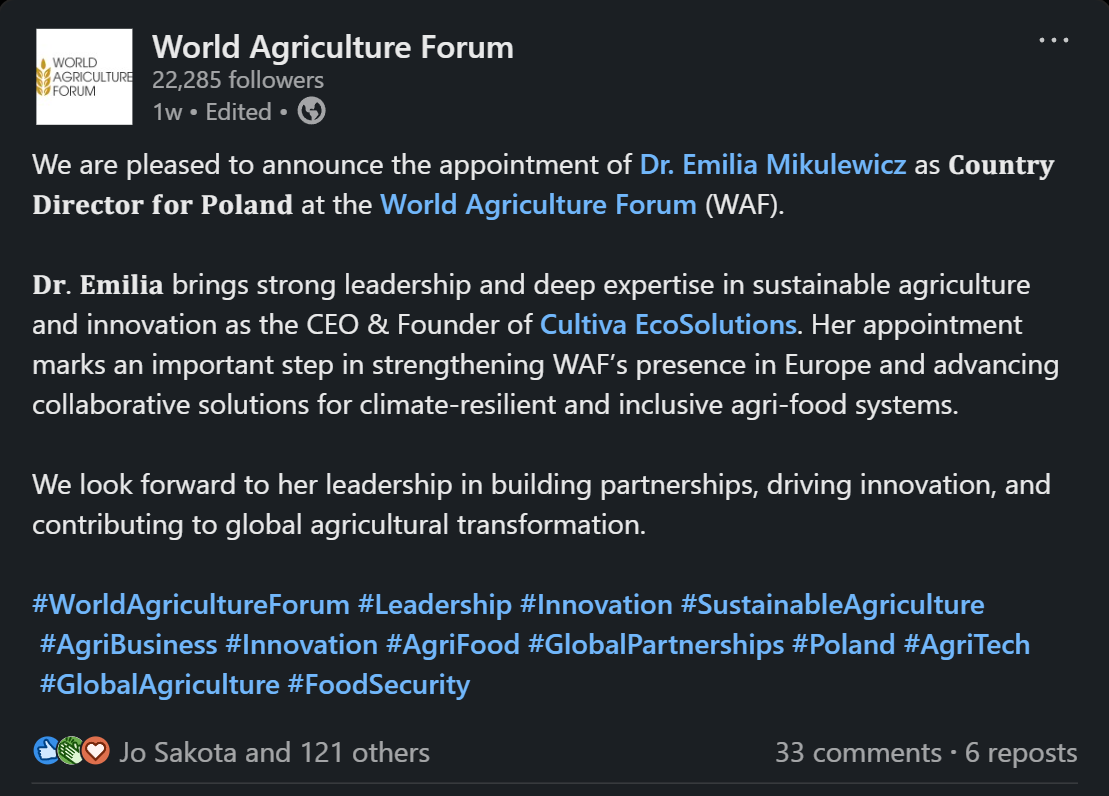
Dr. Mikulewicz is the Founder and CEO of Cultiva EcoSolutions. The appointment follows her earlier appointment to the World Agriculture Forum Council in September 2025 and sits within the Forum’s broader international structure focused on dialogue around sustainable agriculture, agricultural innovation, food security, and the future of agri-food systems.
Her work is particularly associated with a systems-based agronomic perspective that connects crop performance with water management, climate, microbiological processes, production design, and the practical realities of compliance, quality assurance, and commercial production.
Why the WAF Poland Country Council Matters
The establishment of the WAF Poland Country Council matters because it places Poland more clearly within an international framework intended not only for visibility, but for practical alignment between domestic agricultural priorities and wider global agendas.
Within the World Agriculture Forum’s architecture, country-level councils are designed to connect governments, farmers, agribusinesses, experts, and development institutions, while helping translate broader international priorities into country-level dialogue, partnerships, and strategic coordination.
This matters especially at a time when agricultural systems are being shaped by pressures that are increasingly interconnected but too often addressed in fragmented ways: climate risk, input volatility, regulatory demands, market exposure, sustainability expectations, and the operational constraints faced by producers themselves. In that context, the value of country-level leadership lies not only in representation, but in the ability to translate between institutional ambition and practical agricultural reality.
Its significance lies not simply in representation, but in the capacity to create a stronger two-way institutional linkage: bringing Polish sector realities, producer-level constraints, and emerging priorities into wider international exchange, while also helping ensure that broader strategic discussions on sustainability, innovation, resilience, and food systems are interpreted in ways that remain credible at farm and market level.
A Role Within the WAF Poland Country Council
Within the WAF Country Councils framework, the appointment is part of a structure designed to translate international agendas into country-level dialogue and action. WAF states that these councils are intended to localize governance, distribute leadership, and strengthen linkages between governments, farmers, industry, and development partners.The launch of the WAF Poland Country Council is planned for later this year, together with the announcement of around 50 nominations spanning public policy, science, farmer representation, industry, technology, finance, sustainability, and market-linked parts of the agri-food system.
For Polish stakeholders, part of the significance of this model lies in its institutional depth. The World Agriculture Forum’s broader governance and advisory architecture includes participation from individuals with backgrounds in organisations such as CGIAR, ICRISAT, FAO, Cornell, and IFPRI, alongside experience spanning agricultural research, food systems, public policy, agribusiness, and trade. This gives the Poland Council a clearer institutional setting from the outset as a national platform linked to a wider international framework for dialogue and cooperation.
Poland’s Strategic Importance in European Agriculture
This institutional development also carries wider relevance because Poland is not a peripheral agricultural market, but one of the more consequential agri-food systems in Europe.
The establishment of the WAF Poland Country Council matters because Poland is not a marginal agricultural market, but one of the more consequential agri-food systems in Europe. The European Commission notes that the share of agriculture, forestry and fisheries in Poland’s gross value added is around twice the EU average1, underlining the sector’s unusually high economic and social weight in the country.
It also maintains substantial agri-food export capacity. Official trade data show that in the first ten months of 2025, Polish agri-food exports reached EUR 48.5 billion, rising 8% year on year, with a positive trade balance of EUR 16.4 billion2.
High-value horticulture adds further strategic relevance. Trade.gov.pl describes Poland as the EU’s second-largest blueberry producer and sixth globally, with blueberry harvests reaching 64,000 tonnes in 2022, exports going to 38 countries, and export value rising to EUR 107.3 million3. Apples add even greater weight to that position: Eurostat reports that Poland accounted for 34% of all EU apple production in 2022, while official Polish sources indicate annual apple output averages around 3.5 million tonnes4.
This reinforces Poland’s significance not only as a major producer, but also as an internationally connected horticultural market with growing relevance in higher-value fruit trade.
Continued Focus on Dialogue and Collaboration
The appointment reflects the growing importance of internationally connected agricultural leadership at a time when production systems are being reshaped by climate risk, market volatility, regulatory pressure, digitalization, and the need for more resilient operating models.
It also points to the value of credible dialogue that links practical farm realities with wider strategic discussions on sustainability, innovation, entrepreneurship, food systems transformation, and the future direction of agriculture.
References
- European Commission (n.d.). Poland – CAP Strategic Plan. Agriculture and Rural Development . 🌐 Language: | View Source
- Trade.gov.pl (2026, January 22). Poland’s food exports on the rise. Trade.gov.pl . 🌐 Language: | View Source
- Trade.gov.pl (2024, January 17). Polish blueberries at the world level. Trade.gov.pl . 🌐 Language: | View Source
- Eurostat (2024, March 1). Fruit and vegetable production in 2022. Eurostat News Articles . 🌐 Language: | View Source