Why Food Fraud in Plant-Origin Products Becomes Harder to Detect After Harvest
In many plant-origin raw materials, authenticity risk becomes hardest to control after harvest, when drying, blending, repacking, documentation, and trade begin to separate the product from its original identity. That is why food fraud in these supply chains cannot be understood only through production. In processed botanicals such as oregano, a major part of the vulnerability lies in what happens once the crop enters the post-harvest chain.
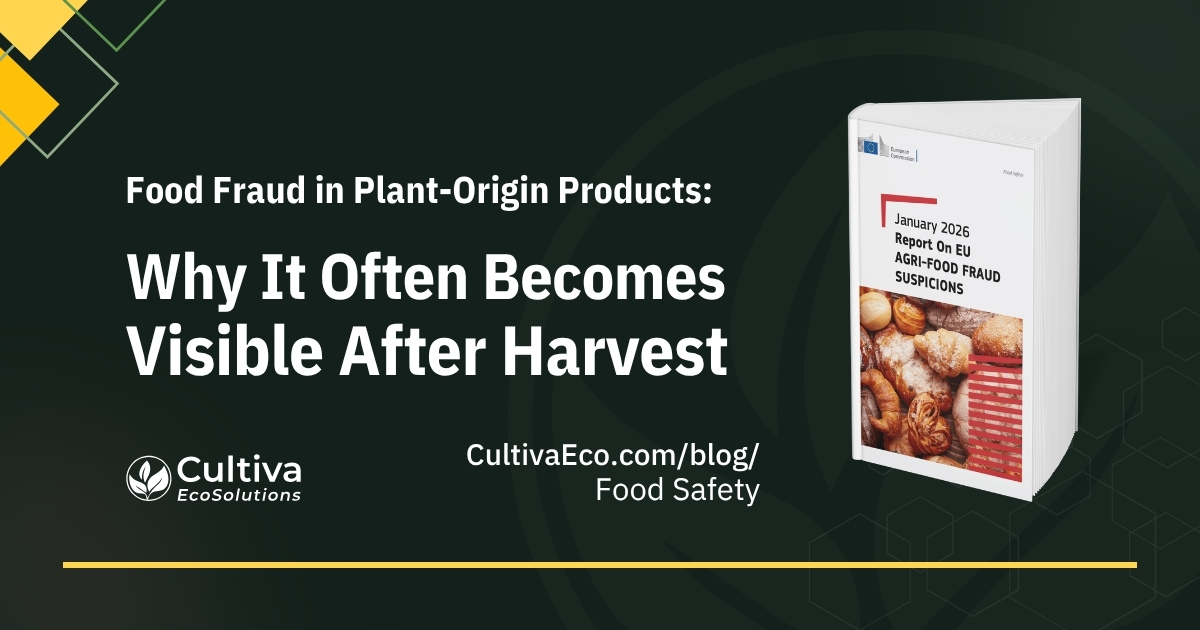
The European Commission’s monthly reports on EU agri-food fraud suspicions are designed to surface cross-border non-compliances that raise fraud concerns, and the January 2026 report included an oregano entry described as containing 51.2% olive leaves and 48.8% myrtle leaves1. Importantly, these reports record suspicions that can trigger investigation, not legally confirmed fraud findings1.
Why Food Fraud Risk Is Not Just a Production Issue
In technical discussions, there is a strong tendency to start with cultivation: how the crop was grown, what conditions shaped it, and whether primary production followed good practice. That is understandable, because the field is visible, concrete, and agronomically meaningful. Yet the European Commission’s own framing of agri-food fraud makes clear that fraudulent or deceptive practices can occur across production, processing, and trade, and that the affected purchaser can be either the final consumer or another operator in the chain.
This broader framing changes the center of gravity. The issue is not only agronomic, but also custodial and commercial. A crop can be well grown and still become commercially compromised later if mixed lots blur boundaries, relabelling weakens accuracy, or documentation cannot support what the product actually is. Production quality is one layer of protection, but post-harvest control determines whether authenticity remains defendable through trade.
Why Oregano Reveals Post-Harvest Food Fraud Risk
Oregano is a useful example because it shows how vulnerable a plant-origin raw material can become once traded in dried, crushed, or fragmented form. In the January 2026 EU monthly report, the oregano case did not suggest only minor contamination or routine quality drift. It referred to a lot reported as consisting of 51.2% olive leaves and 48.8% myrtle leaves. Even without pre-judging the final regulatory outcome, the case shows how extreme substitution can become when dried botanical material moves through a chain with weak identity preservation.
Oregano is also not an isolated choice for discussing authenticity risk. In the Commission’s coordinated control plan on herbs and spices, nearly 10,000 analyses were carried out on 1,885 samples, and oregano emerged as the most vulnerable product in the survey, with 48% of samples considered suspicious of adulteration, most often involving olive leaves2. That does not mean every oregano supply chain is compromised. It means oregano is a category in which authenticity pressure is already well documented, especially when product form and market structure make visual or routine verification weak.
The point is not that fraud always begins at one later stage. It is that post-harvest handling can create the conditions in which authenticity failures become harder to detect, harder to challenge, and more likely to pass through trade unnoticed. That is why the next question is not only whether a crop was well produced, but where product identity is actually lost after harvest.
Where Plant-Origin Product Identity Is Lost After Harvest
The critical point is that authenticity failures often accumulate through ordinary commercial steps that appear routine. Drying changes the physical form of raw material. Blending can obscure lot boundaries. Repacking can detach the product from its supplier context. Consolidation can mix material from multiple sources under one commercial name. Documentation gaps, weak supplier approval, and relabelling then compound the problem by weakening the ability to reconstruct composition, origin, and handling history.
A typical vulnerability pattern does not begin with an obviously fraudulent act. It can begin when dried botanical material from different suppliers is consolidated under one commercial description, then repacked after partial documentation review, with visual checks treated as sufficient because the product is already crushed or fragmented.
At that point, the product may still move with apparently complete paperwork, yet the practical link between the physical lot and its true composition has already weakened. If supplier approval, segregation records, and batch reconciliation are not robust, a later authenticity question becomes much harder to resolve. Post-harvest control is therefore not a secondary administrative layer, but a primary defense of product identity.
This is especially relevant in herbs and spices, where official EU material describes a global, complex chain with multiple stages and intermediaries2. The Commission also notes that processed herbs and spices, especially ground or crushed forms, are more susceptible to fraudulent practices, and that at consumer level it may be difficult or even impossible to identify problems once products are crushed and mixed2.
How Traceability Protects Authenticity After Harvest
Traceability is often treated as an administrative obligation, but in practice it is one of the core controls that keeps authenticity defendable through post-harvest handling. It does not replace supplier verification, segregation, or specification control, yet without it, suspicious substitutions become much harder to isolate and challenge. EU food law treats traceability as a chain-wide requirement, built around the principle that operators must be able to identify where product came from and to whom it went3.
For plant-origin raw materials, that principle matters because authenticity is not protected by a name alone. It depends on a documented and challengeable path through the chain3. If a batch cannot be clearly tied to its supplier, processing history, segregation status, and onward destination, then substitution becomes harder to contest even before any laboratory question arises. Traceability therefore serves more than recalls or legal compliance. It underpins product credibility and gives operators a basis for verifying, isolating, or challenging suspicious material.
Why Good Cultivation Alone Cannot Protect Authenticity
A common mistake in agri-food thinking is to speak about raw material quality as though it were determined entirely at production stage. That is only partly true. Good agronomy can improve crop health, consistency, and baseline quality, but it cannot by itself guarantee that the marketed product will remain authentic through drying, storage, blending, transport, repacking, and trade. Once a crop is commercialized into a more abstract raw material form, protection depends on operational discipline as much as on cultivation discipline.
This is also where vulnerability, non-compliance, and fraud should be distinguished more clearly. Post-harvest complexity creates vulnerability. Weak controls can allow substitution or other non-compliances to pass through the chain. Fraud begins where deception is intentional and linked to undue advantage. Not every weakly controlled product is fraudulent, but every weakly controlled product is more exposed to authenticity failure.
What Stronger Post-Harvest Integrity Controls Look Like
A stronger response starts with a more realistic view of where vulnerability sits. For plant-origin raw materials, especially botanicals, herbs, and spices, supply-chain integrity depends on controlled segregation, tighter supplier verification, clearer botanical specifications, disciplined batch records, controlled blending decisions, and stronger oversight of repacking and relabelling points. The aim is not bureaucratic excess. It is to reduce the spaces in which a product can gradually stop matching what the paperwork claims.
For businesses reviewing their exposure, the more useful question is not simply whether the crop was well produced, but whether the chain can still prove what the product is after commercial handling, consolidation, and trade. That is where a more mature approach begins. In plant-origin raw materials, cultivation matters, but authenticity is ultimately protected by whether the post-harvest system can still defend identity.
Where that kind of review is needed, Cultiva EcoSolutions can support it through practical work on post-harvest quality systems, traceability logic, and compliance-oriented assessment for plant-origin supply chains where authenticity controls genuinely matter.
References
- European Commission (2026). January 2026 – Monthly Report on EU Agri-Food Fraud Suspicions. 🌐 Language: | View Source
- European Commission Joint Research Centre (JRC) (2021). Results of an EU Wide Coordinated Control Plan to Establish the Prevalence of Fraudulent Practices in the Marketing of Herbs and Spices. EUR 30877 EN. 🌐 Language: | View Source
- European Parliament and Council of the European Union (2002). Regulation (EC) No 178/2002 of the European Parliament and of the Council of 28 January 2002 laying down the general principles and requirements of food law, establishing the European Food Safety Authority and laying down procedures in matters of food safety. Current consolidated version. 🌐 Language: | View Source