Winter Stress in Basil in CEA: Key Mechanisms and Risks
In controlled environment agriculture (CEA), winter stress in basil is not a single factor but a set of interacting constraints. Thai basil is a crop adapted to warm conditions; when air and leaf temperatures drop below its comfort zone, basic physiological processes such as transpiration, nutrient uptake and cell expansion slow down. At the same time, rising energy costs push many growers to lower setpoints or accept larger fluctuations between day and night temperatures. The result is a production system where the plant continually has to adjust to cold episodes that it is not adapted to tolerate well.
In CEA systems, the same structures that protect the crop—insulation, tight houses, energy screens—can work against it in winter when they limit air exchange and encourage humid, stagnant layers around leaves. A crop that appears “only slightly stressed” at first glance may already be operating under compromised conditions, with reduced photosynthetic activity and weakened defences. When this state is prolonged over weeks, foliage quality declines, shelf life shortens and the risk of opportunistic pests and pathogens increases, even before any obvious lesions or rot appear.1
Winter Stress Symptoms in Basil: Leaf Curling, Twisting and Deformation
One of the earliest visible signs of winter stress in Thai basil is leaf curling and twisting. Instead of a flat, turgid leaf blade, the lamina begins to roll inwards or twist along the midrib, and young leaves may emerge distorted or uneven in size. These deformations are not only cosmetic. They signal that cells are expanding unevenly, that leaf tissues are responding to mechanical or osmotic stress, or that stomatal behaviour is disrupted by the surrounding microclimate. In many cases, the grower first notices these subtle changes during the coldest weeks of the year or after a series of particularly cold nights.
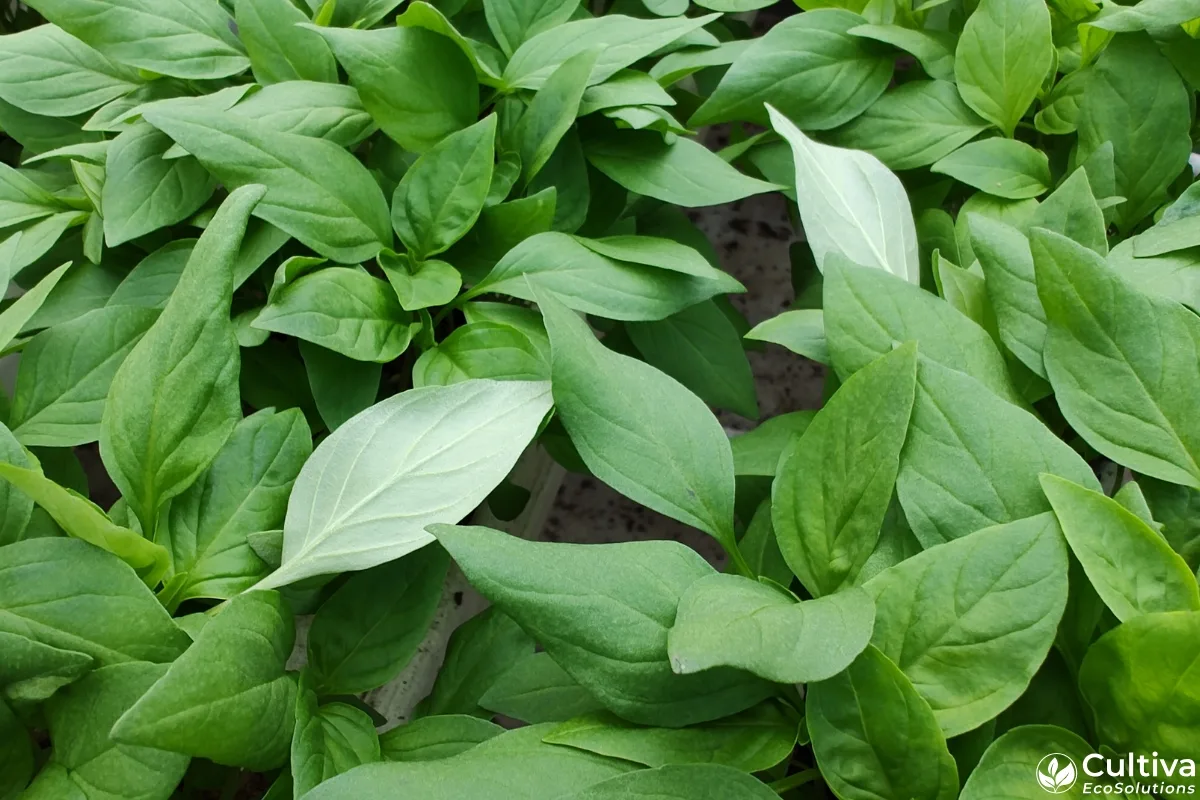
From a market perspective, these visual defects matter because they alter the perceived freshness and uniformity of the product. Stressed basil tends to dehydrate more quickly after harvest, bruise more easily and show a shorter shelf life. Curled or twisted leaves also trap free moisture more readily, which can accelerate decay in packed product. As customer expectations for appearance and shelf life rise, small changes in leaf shape can translate into higher rejection rates, more returns and a higher probability of complaints—even if the crop has not suffered catastrophic yield loss.
Low Temperatures and Cold Nights in Basil Production: Primary Winter Stress Drivers
Low temperature, especially at night, is often the primary driver of winter stress in basil. As temperatures drop, membrane fluidity decreases, enzymatic activity slows, and the plant’s ability to move water and nutrients through the xylem is reduced. Thai basil, adapted to warmer climates, is particularly sensitive to sudden dips or long periods below its optimal range. Night-time cold is especially problematic because it coincides with the plant’s natural recovery and maintenance period; instead of consolidating growth, the plant is forced to cope with stress. 2 3 4
When energy prices rise, it is understandable that growers lower night setpoints to manage heating costs. However, there is a threshold below which savings in fuel quickly translate into loss of quality and additional risk. Repeated exposure to cold nights can leave basil chronically under stress, even if daytime temperatures look acceptable. Leaves then show curling and deformation, stems may thicken or become brittle, and the crop becomes more susceptible to opportunistic pathogens that exploit weakened tissues. The challenge is to define a realistic minimum temperature strategy that balances cost constraints with the plant’s biological needs.
Winter Ventilation, Humidity and Air Movement in Basil Greenhouses
In winter, many growers reduce ventilation to retain heat, but this decision has direct consequences for humidity and air movement around basil canopies. Without adequate air exchange, moisture released by transpiring leaves accumulates, leading to high relative humidity and a saturated boundary layer close to the leaf surface. Under these conditions, leaves dry slowly after irrigation or condensation events, and the plant may respond with stress symptoms such as curling and a duller surface appearance.
Stagnant, humid air is also favourable for fungal pathogens. Even when no visible infection is present, conditions that favour Botrytis cinerea or Pythium spp. may be regularly occurring. Spores need free moisture and susceptible tissues; both become more common when leaves remain wet and plants are weakened by cold. From the grower’s point of view, the problem can remain hidden until a sudden outbreak or post-harvest decay appears. Adjusting ventilation, using horizontal airflow or mixing fans, and managing humidity targets are therefore not just comfort measures but core elements of winter stress management in basil crops.
Substrate Moisture, Root-Zone Conditions and Nutrient Uptake in Winter Basil Crops
Winter stress in basil is often intensified at the root zone. When substrates remain too wet in cold conditions, oxygen diffusion is limited and root respiration is constrained. The root system becomes less efficient at capturing water and nutrients, even if the solution composition is correctly formulated. Cold, saturated media suppress active uptake of key ions such as potassium, calcium and magnesium, and can trigger deficiency-like symptoms in the foliage despite regular fertigation.
As nutrient uptake slows, leaves may show subtle chlorosis, marginal burn, or atypical curling that is easily misattributed to pests or varietal traits. At the same time, cold, wet substrates favour root diseases such as Pythium spp., which further reduce functional root volume. Managing winter irrigation therefore requires a different strategy than in summer: longer drying periods between events, more attention to drain volumes, and careful monitoring of root-zone temperature. Bringing the substrate back into a more aerated, temperature-appropriate range is often a prerequisite for stabilising plant appearance and reducing complaint rates.
LED Lighting Conditions and Their Interaction with Winter Stress in Basil
Lighting conditions, especially in LED-lit CEA systems, interact with winter stress in basil in several ways. Inadequate intensity or an imbalanced spectrum can limit the plant’s photosynthetic capacity just when colder temperatures are already slowing metabolism. If light levels are low, plants may remain in a quasi-maintenance state, failing to build robust tissues and becoming more sensitive to any additional stress. On the other hand, high light in a cold environment can create its own imbalance, with light energy arriving faster than the plant can process it at reduced temperatures.
Spectrum also matters. A well-balanced LED spectrum tailored to basil supports compact, healthy growth and can help maintain leaf colour and texture when climate is less than ideal. However, lighting alone cannot compensate for systemic issues such as chronically low temperature or poor air movement. Effective winter management treats lighting as one part of an integrated system that includes temperature control, humidity management, airflow, and root-zone conditions. Fine-tuning photoperiod and spectrum in the context of these other variables, rather than in isolation, is what helps maintain stable quality across the winter months.5
Practical Steps to Reduce Winter Stress in Basil and When to Seek External Support
For most basil producers, the goal in winter is not to reach “perfect” conditions, but to bring key parameters back into a range that the plant can tolerate without continuous stress. Practical steps often include defining realistic minimum night temperatures, even if they are slightly higher than the absolute lowest affordable setpoint; improving air movement with fans to break up stagnant layers; and using controlled ventilation or dehumidification to keep relative humidity within a band that limits free moisture on leaves. Revisiting irrigation strategies to avoid permanently wet substrates and monitoring root-zone temperature are equally important. Small adjustments across these areas tend to deliver more reliable results than a single, dramatic change in one variable.
When recurring symptoms persist—chronic leaf curling, quality complaints in winter, or unexplained variability between bays—it can be useful to invite an external perspective. An independent advisor can help interpret climate and irrigation logs, inspect root systems, and connect visual symptoms with specific environmental drivers. Cultiva EcoSolutions, for example, supports CEA producers by reviewing climate settings, root-zone conditions and lighting programs in an integrated way, then outlining practical, site-specific adjustments. The objective is not to replace the grower’s expertise, but to provide a structured diagnosis that reduces uncertainty and helps the team move from recurring winter problems to a more stable, predictable basil crop.
Frequently Asked Questions About Winter Stress in Basil in Controlled Environment Agriculture (CEA)
In controlled environment agriculture (CEA), winter stress in basil is a combination of low temperature, high humidity, stagnant air and cold, wet substrates that pushes basil outside its physiological comfort zone. When leaf and root-zone temperatures drop, transpiration, nutrient uptake and cell expansion slow down, foliage quality declines and shelf life shortens. Over time this chronic stress weakens plant defences and makes basil more vulnerable to opportunistic pests and pathogens, even before visible lesions or rot appear.
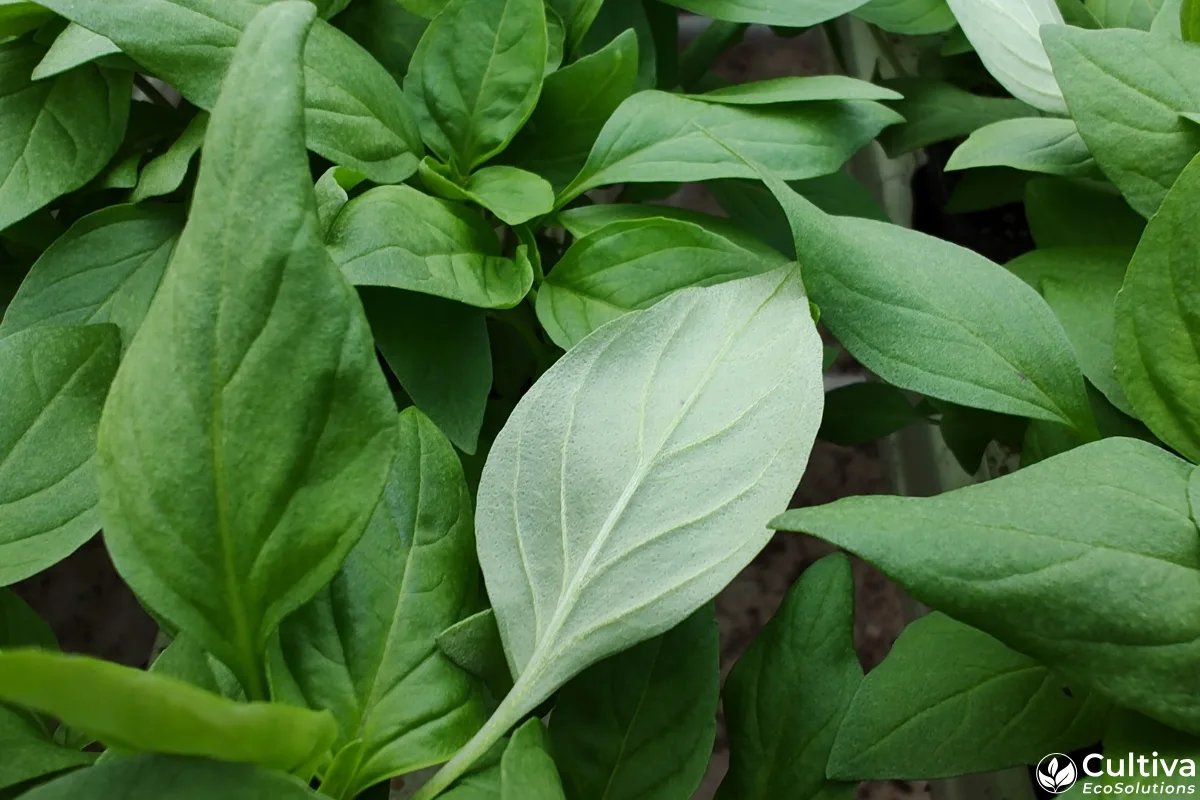
Early winter stress in Thai basil often appears as leaf curling, twisting and subtle deformation. Instead of flat, turgid leaves, the lamina starts to roll inwards or twist along the midrib and new leaves may emerge uneven in size. Canopies can still look marketable, but individual leaves become slightly paler, change angle or dehydrate faster after harvest. These changes are early signals that the microclimate or root zone is already outside the optimal range and should be corrected before more severe spotting, necrosis or quality complaints appear.
Low night temperatures reduce membrane fluidity and enzymatic activity in basil, slowing water and nutrient transport in the xylem at the exact time plants should recover from daytime stress. When growers also limit winter ventilation to save energy, humidity accumulates and air movement around the canopy falls, creating humid, stagnant layers around leaves. This combination of cold nights, high relative humidity and poor airflow drives chronic stress symptoms such as curling, dull surfaces and thicker or brittle stems and it increases the risk of Botrytis and Pythium even before visible outbreaks occur.
In winter, cold and saturated substrates limit oxygen diffusion and root respiration, so basil roots cannot absorb water and nutrients efficiently even when the fertigation recipe is correct. Uptake of key ions such as potassium, calcium and magnesium slows, which can cause chlorosis, marginal burn and atypical curling that is easily misdiagnosed. A winter strategy should include longer drying periods between irrigations, closer tracking of drain volumes and monitoring root-zone temperature. Bringing the substrate back into a more aerated and temperature appropriate range is often essential to stabilise plant appearance and reduce complaint rates.
In LED lit CEA systems, lighting conditions interact closely with winter stress in basil. If light intensity is too low, plants remain in a maintenance state and build weak tissues that are more sensitive to cold and humidity. If intensity is high while temperatures are low, light energy exceeds the plant capacity to use it and physiological stress increases. A well balanced LED spectrum tailored to basil, combined with realistic minimum night temperatures, controlled humidity, adequate airflow and stable root-zone conditions, helps maintain colour, texture and shelf life in winter. Fine tuning photoperiod and spectrum should always be done in the context of climate and irrigation data rather than in isolation.
References
- Cámara-Zapata, J.-M. , Sánchez-Molina, J. A. , Rodríguez, F. & López, J. C. (2019). Evaluation of a dehumidifier in a mild weather greenhouse. Applied Thermal Engineering , 146, 92–103. 🌐 Language: | View via FAO AGRIS
- Chang, X. (2004). Effect of light and temperature on volatile compounds and growth parameters in sweet basil (Ocimum basilicum L.). University of Nottingham . 🌐 Language: | View Thesis (PDF)
- PlantHealth (2022). Physiology of cold and frost-related stress. PlantHealth – Applied Knowledge . 🌐 Language: | View Article
- VanDerZanden, A. M. (2008, reviewed 2024). Environmental factors affecting plant growth. OSU Extension Service . 🌐 Language: | View Article
- Sipos, L. , Balázs, L. , Székely, G. , Jung, A. , Sárosi, S. , Radácsi, P. & Csambalik, L. (2021). Optimization of basil (Ocimum basilicum L.) production in LED light environments – a review. Scientia Horticulturae , 289, 110486. 🌐 Language: | View Article